
Smoke D’vil
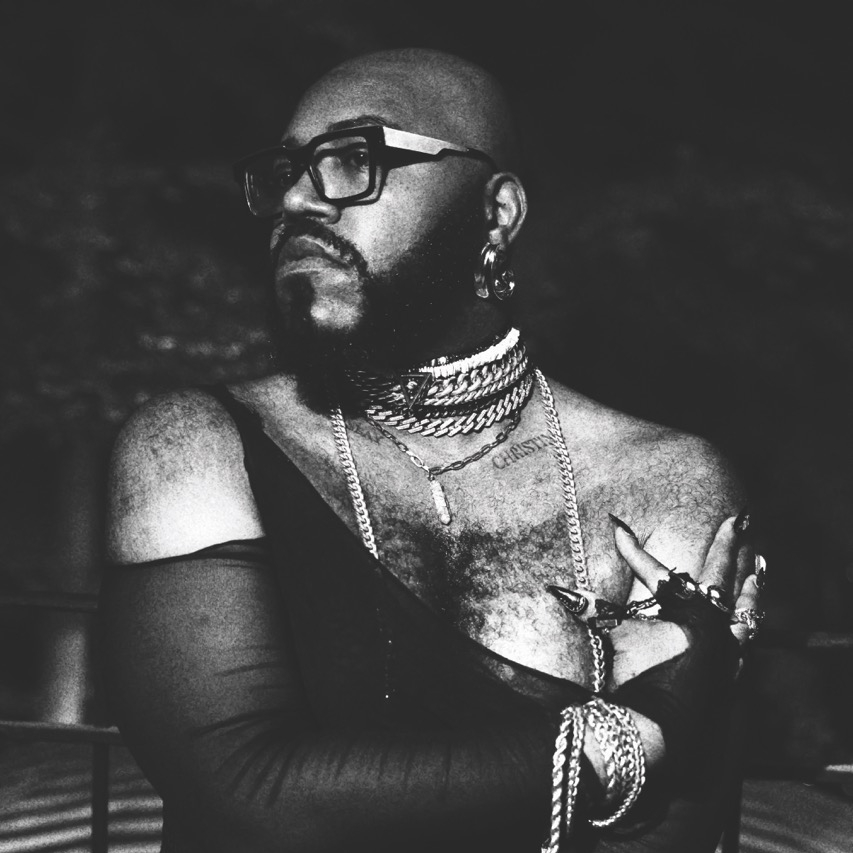

There is something delicious about a man who refuses to be reduced to a single version of himself.
Smoke D’vil exists in the tension between darkness and tenderness, sexuality and vulnerability, mystery and warmth. He can enter a room with an energy that feels almost dangerous, yet beneath the leather, the tattoos, the black and grey aesthetic, and that unmistakably seductive presence is someone deeply introspective—someone still becoming. Smoke describes himself simply as a man trying to find his way through life and become the healthiest version of himself. That humility is perhaps the most unexpected thing about him.
Smoke is not a costume. He is a permission slip.
When he steps onto the box to dance or walks into a gay bar, something shifts. The everyday self gives way to someone more tactical, observant, sensual, playful, and fearless. Smoke doesn't need to be the loudest person in the room. His power comes from watching, taking everything in, and moving with intention. There is seduction in that restraint—a knowing quality that says he doesn't have to chase attention because attention naturally finds him.
And then there is the darkness.
For Smoke, darkness isn't synonymous with sadness or destruction. It is controlled chaos. It is a place where sexuality, emotion, vulnerability, anger, beauty, and transformation can exist together. He has experienced moments of pain, trauma, anger, and self-destruction, but he refuses to let those experiences become the entirety of his story. Instead, he has learned to take what once hurt and transform it into expression. Into identity. Into art. Into something beautiful.
Perhaps that is what makes Smoke so compelling.
He understands that the things we are taught to hide can sometimes become the very things that make us magnetic.
His relationship with darkness began long before the name Smoke D’vil existed. It lives in the music of his childhood, particularly Depeche Mode's Enjoy the Silence, introduced to him through his mother. It lives in alternative music, mythology, dragons, ancient Egypt, cats, and the mysterious worlds that captured his imagination. Later, another woman—someone he refers to as Mary—introduced him to goth culture and artists that gave language to something he had already been feeling. Looking back, Smoke recognizes that the women who influenced him opened different doors into the person he would eventually become.
There is something beautifully intimate about that realization.
Because Smoke's aesthetic isn't simply armor.
It's expression.
The darker masculine pieces mixed with softer or more feminine details aren't designed to conceal him. They allow him to play with himself—to experiment with contrast, texture, energy, and identity. He doesn't believe he has to choose between being masculine and soft, sexual and sensitive, dark and loving. He can be all of it. And perhaps the real liberation is understanding that contradiction isn't something that needs to be resolved.
That same complexity follows him into sexuality.
There is an important distinction Smoke understands intimately: being sensual does not mean being available.
The image may be provocative. The performance may be erotic. The body may become part of the fantasy. But fantasy still requires boundaries. Smoke speaks openly about the assumptions people can make about him because of the way he looks and performs, particularly the idea that sexual expression somehow gives others permission to cross personal boundaries. It doesn't. His sensuality belongs to him. His performance belongs to him. His body belongs to him.
That boundary makes his sexuality even more powerful.
Because there is intention behind it.
Smoke knows the difference between being looked at and being possessed. Between performing desire and surrendering autonomy. Between creating fantasy and giving someone access.
And perhaps that is why the name feels so fitting.
Smoke came from Mortal Kombat—a character whose sinister, shadowy energy resonated with him. D’vil comes through the lineage of the House of D’vil, connecting him to a chosen family and a history that carries its own wicked mythology. Together, the name becomes something greater than a stage identity. It becomes a language for a particular part of himself: darker, tactical, sensual, observant, and unapologetically alive.
But Smoke's story becomes even more interesting when we look beneath the seduction.
Before Smoke, there was a man carrying an enormous amount of anger.
He describes a decade of recklessness, partying, drinking, heavy drug use, distrust, and choices that could have cost him his life. There was pain underneath the chaos, and for a long time he didn't have the tools to understand what to do with it. Smoke didn't erase that person. He acknowledges that person. The difference is awareness. Growth. Learning how to recognize his patterns and make different choices.
That evolution matters.
Because transformation is rarely glamorous while you're living through it.
Sometimes transformation looks like asking for help. Sometimes it looks like leaning on the people who genuinely care about you. Sometimes it looks like waking up after another night of choices you aren't proud of and deciding that you don't want to keep repeating the same story.
Smoke reached a point where he became tired of being that version of himself.
And he chose differently.
Now, he speaks about being in a much better place with an honesty that doesn't require pretending the past never happened. There is no polished redemption fantasy here. There is simply a man who recognizes where he has been, understands that becoming whole is ongoing, and takes pride in the work required to keep moving forward.
That might be the sexiest thing about him.
Not the body.
Not the leather.
Not the stage.
The becoming.
Because Smoke D’vil isn't interesting simply because he is beautiful in the darkness. He is interesting because he understands that darkness can hold tenderness. That sexuality can coexist with boundaries. That masculinity can have softness. That vulnerability can live alongside power. That a person can carry scars without allowing those scars to become their entire identity.
There is a sweetness beneath the sinister.
Smoke describes himself as someone with a genuinely tender heart—someone who cares deeply about the people he allows close and wants those people to feel seen, accepted, and understood. The toughness and mystery may be what strangers notice first, but softness is what emerges with trust.
And trust, perhaps, is the secret ingredient.
Smoke doesn't give every part of himself away.
He reveals.
He teases.
He performs.
He watches.
He decides.
And when he finally lets someone closer, there is something profoundly intimate about being allowed beyond the aesthetic and into the heart underneath it.
That is where Smoke D’vil becomes more than a performer.
He becomes a story about reclamation.
A man taking every contradictory piece of himself—the darkness, the sexuality, the anger, the softness, the curiosity, the pain, the humor, the beauty—and refusing to throw any of it away.
Instead, he wears it.
He dances in it.
He turns it into art.
And when the lights come up and the music starts, Smoke D’vil steps into the room carrying every version of himself with him.
Not hiding the darkness.
Not apologizing for the desire.
Not pretending the past didn't happen.
Just moving forward—beautifully, deliberately, and with a little sin in his step.
Smoke doesn't simply dance with the dark.
He knows how to make the dark dance back.


Comments